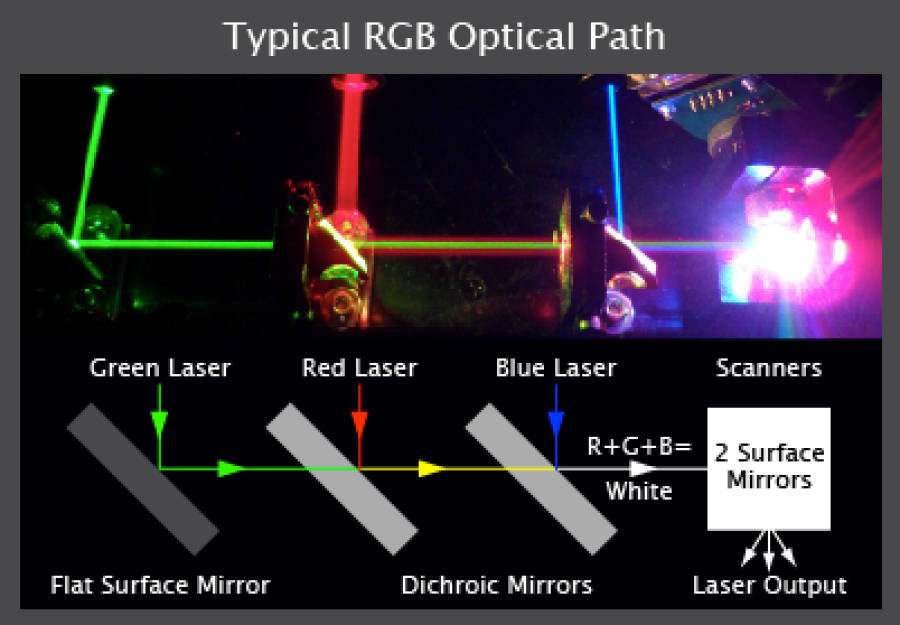
Understanding What Determines A Quality LaserLasers come in all shapes, sizes and prices. We are often asked why one laser that appears similar to another at first glance, has such a different price tag. The Quality Equation is our answer to help put an end to the common deception that “laser power is the most important factor†which so many other companies focus on. Understanding these relatively simple concepts will help you make the best choice for your unique laser requirement. You should decide what parts of the quality equation are most important to your application when choosing a laser and match those to the interactive and comparison charts we provide at MotionLasers. Overall Quality = Power + Colors + Beam Specs + Optics + Scanners + Construction + Lifespan Power (W) affects brightness and color balance. Multi-color lasers include individual color modules inside the laser chassis that combine to form other colors. For instance, a red module + a green module can combine their output into a yellow beam. Power should be considered for each individual laser module inside your laser not only the total combined power. This ensures you have good color balance. Be aware that power is normally measured at the exit point of the internal laser modules and NOT the exit window of the laser chassis (aka the aperture) which often varies drastically on lower end lasers. For example a 1W laser may loose 30% or more power inside a low-end laser due to poor internal optics and poor construction - thus a low end laser rated at 1W laser may only truely display 600-700mW of visible power.
Color, or wavelength, of each internal laser module is just as important as its power. The measurement is taken in nanometers (nm) which represents the exact color of the module output. The human eye has different sensitivities to each wavelength which can result in massive differences in the beam brightness of different wavelengths. For example a 640nm red laser beam is nearly twice as bright to the human eye as a 655nm red laser beam even at identical power rating. The chart shows human eye sensitivity to the most common laser beam wavelengths.
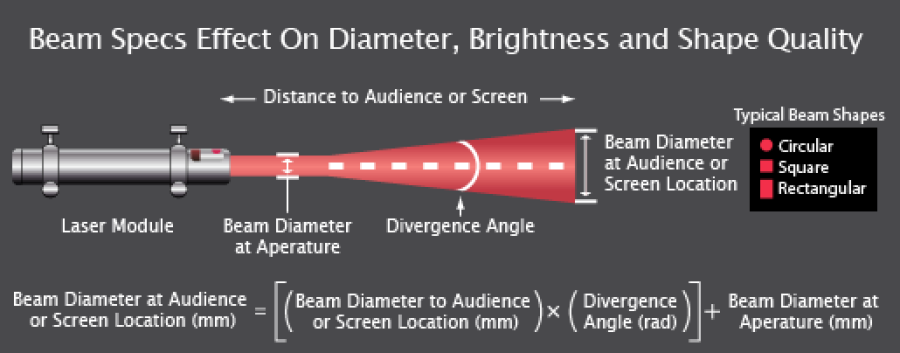
Beam specs have three components: diameter, divergence and shape. Beam diameter is simply the average diameter of the beam measured at the edge of the laser module. Divergence is a measurement of how fast a beam spreads out, or diverges, from that initial diameter. The shape of the beam is usually round or rectangular. This is important depending on your unique application. For example, if you want to display text on a screen, choose a laser with 1-2mm diameter beams and low divergence so that the drawing is tight and precise.
Optics are required inside a laser to redirect and combine the beams but they inherently cause loss in power. The key is ensuring the optics are high quality so you loose as little power as possible before the beams reach the aperture of the laser. Internal optics loss is not usually shown in the manufacturer documentation since it can often offset the maximum power they are required to report to the FDA. For example, if a deceptive manufacturer rates a laser at 1W but the internal optics cause a 30% reduction in power delivered to the audience, this would cause a lot of questions about how that total power rating was determined. It's imporant to note that we provide two power ratings per product on MotionLasers. One if the Manufacturer Stated Max Power. This is what the manufacturer is required to report to regulatory agencies like the FDA but is not the power delivered at the aperture. Guaranteed Visible Power is the rating more useful for side-by-side coparisons as it is the power guaranteed at the apeture. This value is commonly 10-15% less than the manufacturer stated max power due to internal optical loss.
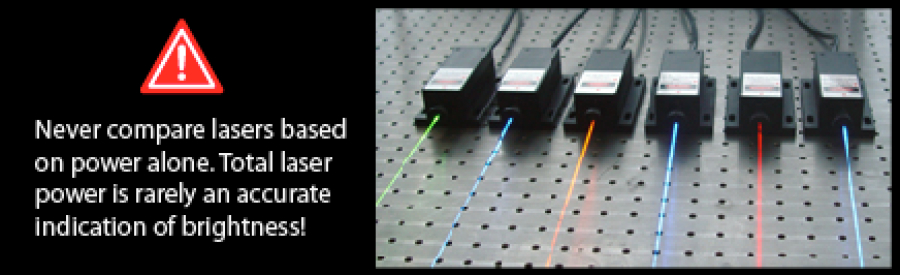
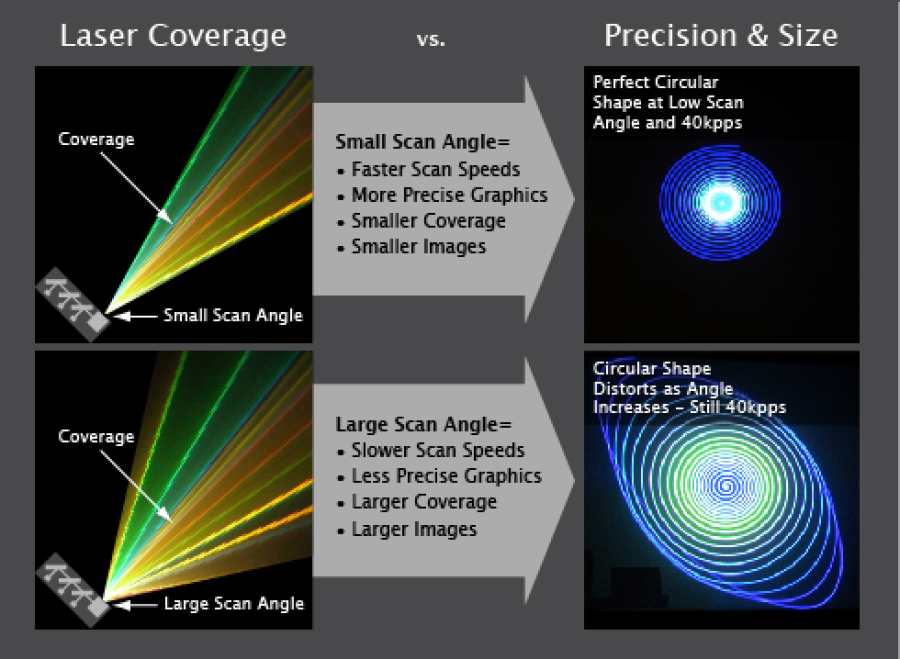
Perceived brightness to the human eye of the laser beam takes into account all of the above: power, wavelengths, beam diameter/divergence and optics quality. Some resellers try to pass off power as brightness but already you can see that there are far more factors that affect brightness - and it is highest brightness at a specific budget that is usually the goal. Scanner speed is a measurement of the max points-per-second (pps) over a given scan angle. This correlates into how accurate and complex beam graphics can be before distorting the graphics or causing laser flicker. Laser flicker is a common artifact observed when scanners can not keep up with the patterns which causes a strobing effect on the beams. Scan angle determines the maximum angle the lasers can exit the projector window and thus determines the max coverage of that laser. Scan speed and scan angle are inversely proportional – that is the larger the scan angle, the lower the max achievable scan speed.
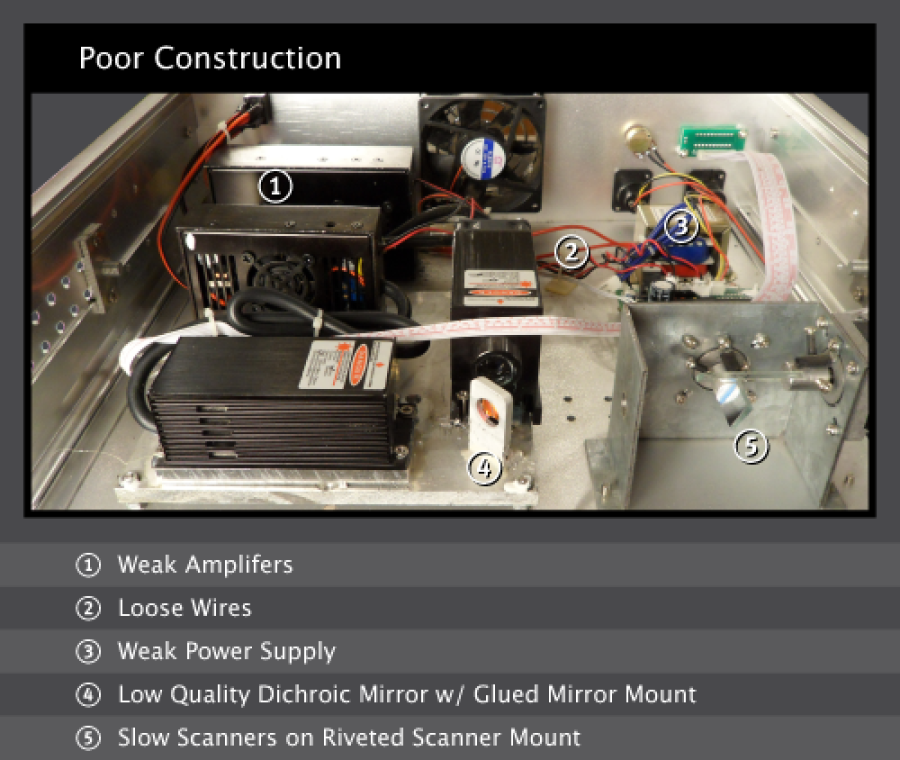
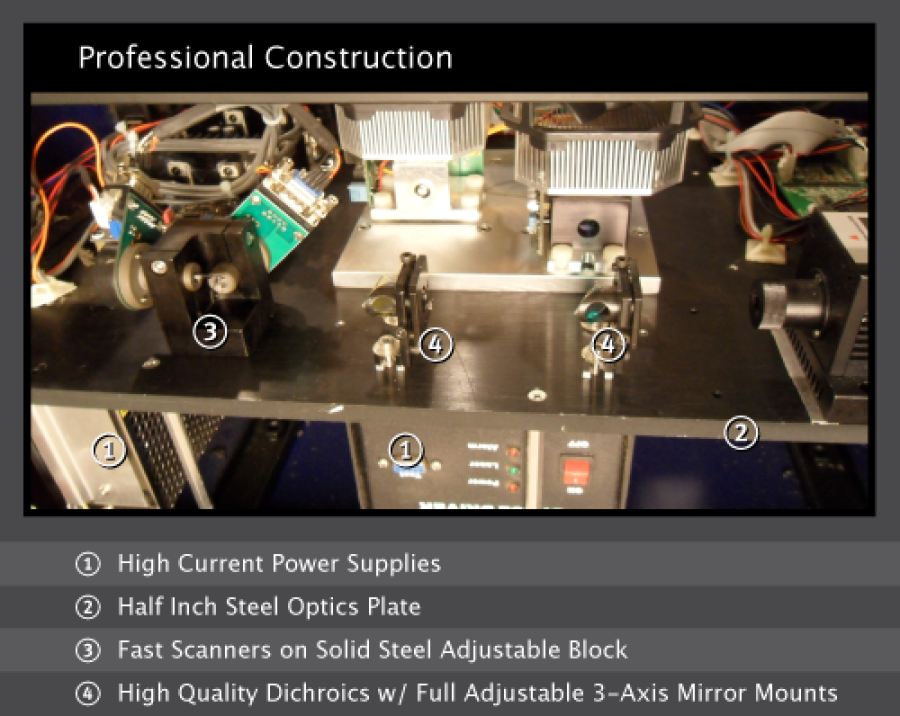
Construction can affect the number of cleanings and optical re-alignments you must perform on the laser over its entire lifespan. High-end lasers are often sealed and airtight, contain air filters and may even have weatherproofing. A well-constructed laser will also have thick metal baseplates, no internally glued parts and a frame designed to minimize flex – which prevents optical misalignment and loss in power under fluctuating temperature conditions.
When properly maintained, professional lasers will give many years of daily use. Their expected lifespan far outlasts traditional lighting often with less maintenance than any other fixture in your lighting inventory. 5-7k hours of use is typical giving many years of trouble free operation.
Now that you know more about how to measure the quality of a laser, jump over to the MotionLasers Comparison Charts and start comparing models brightness and quality for yourself! |
January 27, 2017